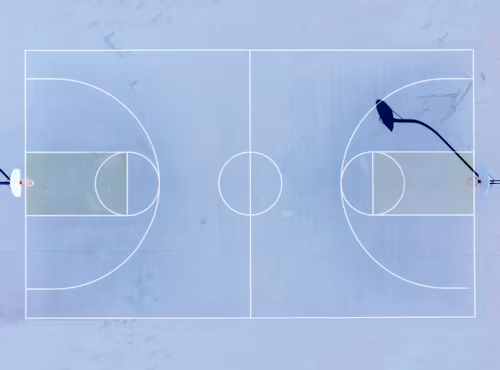


Dunking gets the highlight reel attention, but the players who are most valuable on the basketball court are those who have mastered the fundamentals. Footwork, dribbling, passing, shooting, defense, and court vision are the skills that determine how effective a player is across a full 40-minute game. These fundamentals also build the athletic foundations — coordination, body awareness, quickness, and agility — that underpin explosive jumping ability. Developing them in parallel with jump training produces a more complete athlete.
Footwork: The Foundation of All Basketball Movement
Elite footwork separates good basketball players from great ones. For accurate jump measurements, dunk calculator tools provide the exact figures you need. The ability to change direction quickly, maintain balance during dynamic movements, and execute pivots and cuts with precision requires years of deliberate practice. Footwork drills — ladder drills, cone drills, defensive slides, and pivot practice — develop proprioception and neuromuscular control that carry over into jump training, improving the approach mechanics and takeoff efficiency that translate to greater dunk height.
Dribbling and Ball Handling Skills
Elite ball handling allows players to create their own opportunities, penetrate defenses, and reach the rim to finish — which is where the ability to dunk becomes directly valuable. A player who can drive to the basket and finish with a powerful jam combines two major athletic skills. Ball handling drills — crossovers, between-the-legs, behind-the-back, and hesitation moves — develop coordination and ambidexterity that improve overall athletic fluency.
The Role of Court Vision in Creating Dunking Opportunities
Even with elite athleticism and a 40-inch vertical, you need court vision to recognize and exploit the openings that create dunking opportunities. Developing an understanding of defensive rotations, reading the floor in transition, and anticipating passing angles helps you arrive at the basket at exactly the right moment — which is often the difference between a successful dunk and a contested layup.
Defensive Skills and Athleticism
Basketball defense requires explosive lateral movement, quick reaction time, and sustained athletic output — all of which benefit from the same physical training that improves vertical leap. Athletes who train for the athleticism needed to dunk often find significant improvements in their defensive lateral quickness as a bonus effect. Integrating defensive footwork drills into your training program develops this athleticism while also improving basketball-specific skills.
Conditioning for Full-Game Performance
A player who can dunk in practice but fades in the fourth quarter of games has an athletic profile that needs addressing. Basketball-specific conditioning — which combines aerobic capacity, repeated sprint ability, and the ability to recover quickly between explosive efforts — ensures that your hard-earned athleticism is available throughout a full game. Conditioning work should be progressively developed alongside strength and power training.
Mental Toughness and Competitive Mindset
The mental game of basketball — resilience after turnovers, confidence in clutch moments, coachability, and competitive focus — is as trainable as any physical skill. Athletes who develop mental toughness through deliberate practice, adversity exposure, and reflection become better performers in high-pressure situations. The same mindset skills that drive consistent training for a dunking goal translate directly into competitive basketball performance.